Whether you are buying a bangle online or in store, getting the right size is essential. A bangle that is too tight will not slip over your hand, and one that is too loose will slide off your wrist. This step-by-step guide explains exactly how to measure bangle size at home, what bangle size charts mean, and how to choose the right fit every time.
Why Bangle Size Matters
Unlike bracelets with clasps, bangles are rigid rings that must pass over your knuckles to reach your wrist. This means the fit depends not just on your wrist circumference (the total length around your wrist), but on the width of your hand at its widest point. Getting the measurement right before you buy will save you time, money, and frustration.
What You Will Need
- A flexible measuring tape or a strip of paper and a ruler
- A pen or pencil
- Your dominant hand (or whichever wrist you plan to wear the bangle on)
How to Measure Bangle Size: Step-by-Step

Step 1: Prepare Your Hand
Hold your hand as if you were about to slide on a bangle. Bring your thumb and index finger together so that they are touching, and tuck them inward slightly. This mimics the natural narrowing of the hand when putting on a bangle, and it is the position your hand will be in when you slip a bangle on or off.

Step 2: Measure the Widest Part of Your Hand
Wrap a flexible measuring tape around the widest part of your hand, just below the knuckles, while keeping your thumb and index finger pressed together. This is the most important measurement for bangle sizing.
If you do not have a measuring tape, wrap a strip of paper or a piece of string around your hand in the same position. Mark where the strip meets itself, then lay it flat against a ruler to find the measurement.
Take note if this measurement is in centimetres or millimetres.
Step 3: Convert to Diameter
Because bangles are circular, sellers typically list sizes as an internal diameter (the length of the inside of the bangle) rather than a circumference (the entire length of the bangle).
To convert your hand circumference to a diameter, divide the measurement by pi (3.14):
Diameter = Circumference ÷ 3.14
For example, if your hand circumference is 18 cm:
18 ÷ 3.14 = 5.73 cm (57.3 mm)
This gives you your approximate bangle diameter.
Step 4: Add Ease
For a comfortable fit that slides on and off without difficulty, most people add 1 to 2 mm of ease to their diameter measurement. If you have larger knuckles or prefer a looser feel, add up to 4 mm.
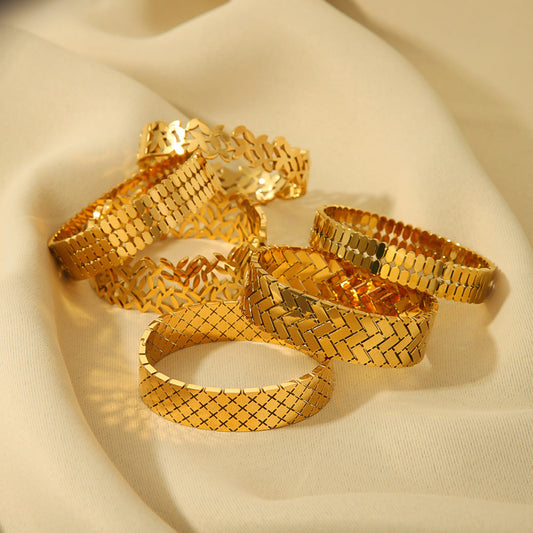
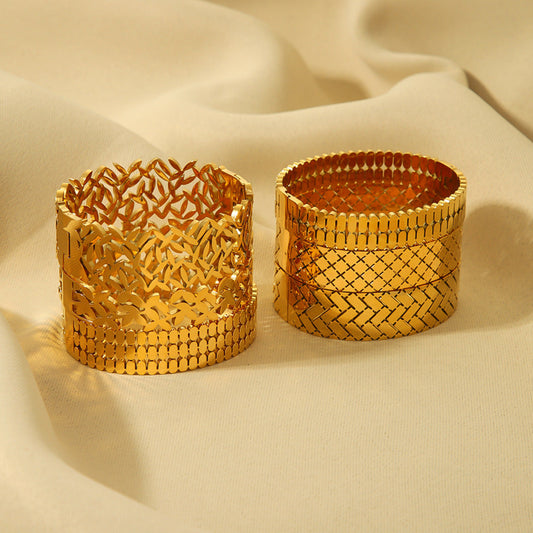
Browse our full bracelet collection at Areei to discover beautiful chunky chains, elegant cuffs, stackable bangles, and statement pieces crafted to elevate any outfit. Shop the collection today and find your next favourite piece.
Bangle Size Chart
The table below shows common bangle sizes and the corresponding hand circumference range. Sizes vary between brands, so always check the individual retailer's size guide.
|
Bangle Size |
Internal Diameter |
Hand Circumference |
|
XS / Size 1 |
56 mm |
Up to 17.5 cm |
|
S / Size 2 |
58 mm |
17.5 cm to 18.0 cm |
|
M / Size 3 |
60 mm |
18.0 cm to 18.5 cm |
|
L / Size 4 |
62 mm |
18.5 cm to 19.5 cm |
|
XL / Size 5 |
65 mm |
19.5 cm to 20.5 cm |
|
XXL / Size 6 |
68 mm |
20.5 cm and above |
How to Measure for a Stacked Bangle Set

If you plan to wear multiple bangles together as a stack, the sizing process is the same. However, keep in mind that a set of bangles will feel slightly tighter on the wrist than a single bangle, so you may want to size up by 1 to 2 mm if you are buying three or more bangles to wear together.
Tips for Getting the Right Bangle Fit
Measure at the right time of day: Hands can swell during warm weather or after physical activity. For the most accurate measurement, take your reading in the morning before exercise or heat exposure.
Consider your knuckles: If your knuckles are noticeably wider than your wrist, size for your knuckles rather than your wrist. The bangle needs to pass over the widest point of your hand.
Account for the bangle width: A wider bangle can feel tighter than a narrow one of the same diameter. If you are buying a wide cuff-style bangle, consider going up by one size.
Check the opening on hinged bangles: Some bangles feature a hinge or a small opening gap. These are easier to put on and do not require sizing in the same way as a solid bangle. Always check whether a bangle is solid or hinged before ordering.
When in doubt, size up: A slightly looser bangle is far more comfortable and practical than one that is difficult to put on and take off.
How to Measure Bangle Size Without a Measuring Tape
If you do not have a measuring tape, here is a simple method:
- Cut a strip of paper approximately 2 cm wide and 25 cm long.
- Hold your hand in the bangle-fitting position (thumb and index finger pressed together, hand relaxed).
- Wrap the paper around the widest part of your hand, below the knuckles.
- Mark where the paper overlaps with a pen.
- Lay the paper flat and measure the distance from the end to your mark using a ruler. This is your hand circumference.
- Divide by 3.14 to get your diameter, then refer to the size chart above.
Frequently Asked Questions
What is the average bangle size for women?
The average bangle size for adult women in the UK is approximately 60 to 62 mm internal diameter, which corresponds to a medium or large in most sizing charts. However, hand sizes vary significantly, so it is always best to measure rather than rely on an average.
What is the average bangle size for men?
Men typically require a larger internal diameter, usually between 65 mm and 72 mm. Always measure the widest part of the hand, as described above.
Can I resize a bangle?
Solid metal bangles can sometimes be resized by a skilled jeweller, though this is not always possible with decorative or engraved pieces. It is far easier to buy the correct size from the outset.
What if my size falls between two sizes?
If your measurement falls between two sizes, it is generally advisable to size up. A slightly roomier bangle is easier to wear and more comfortable over time.
Is bangle size the same as bracelet size?
No. Bracelet sizes are typically based on wrist circumference because bracelets have a fastening mechanism and do not need to pass over the knuckles. Bangle sizes are based on the width of the hand at its widest point. Do not substitute one measurement for the other.
Summary: How to Find Your Bangle Size
- Press your thumb and index finger together to narrow your hand.
- Measure the circumference of your hand just below the knuckles.
- Divide by 3.14 to convert to diameter.
- Add 1 to 2 mm for comfort.
- Compare your result to the retailer's size chart.
Taking just a few minutes to measure correctly before you buy will ensure your bangles fit beautifully, slide on with ease, and stay securely on your wrist.