Stacked rings are one of the most popular jewellery trends of the moment, and it is easy to see why. Layering slim bands, eternity rings and statement pieces on a single finger creates a look that is personal, versatile and endlessly customisable. There is, however, one common frustration that almost every ring-stacker encounters at some point: the rings will not stay put. They twist, they rotate, and before long your carefully curated stack has turned into a jumbled mess facing every direction but the right one.
The good news is that this is a solvable problem. Below, we have put together a thorough guide covering why stacked rings spin in the first place, and the most effective methods for keeping them exactly where you want them.
Why Do Stacked Rings Spin in the First Place?
Before addressing the fix, it helps to understand the cause. Rings spin for a handful of straightforward reasons:
- Fit is too loose. A ring that is even slightly too big for your finger has room to move, and movement leads to rotation.
- Smooth, rounded bands. Rings with a comfort-fit or fully rounded interior have less grip against neighbouring rings and skin.
- Weight imbalance. A ring with a heavier top, such as one set with a large stone, will naturally want to rotate so the heaviest point faces downward due to gravity.
- Daily movement. Washing hands, typing, exercising and general hand movement throughout the day all encourage rings to shift.
- Multiple rings stacked together. The more rings you wear at once, the more surfaces there are sliding against one another, increasing the likelihood that at least one will turn.
Once you know the cause behind your particular spinning issue, it becomes much easier to choose the right solution.

1. Get the Sizing Right
This is the single most important factor, and the one most people overlook. A ring that fits snugly, without being uncomfortably tight, will always be more stable than one that is a size too large. If your stacked rings spin constantly, the first thing worth checking is whether they actually fit correctly. Many jewellers, including our own team, recommend having your ring size properly measured rather than guessing, particularly if you plan to stack multiple pieces on the same finger.
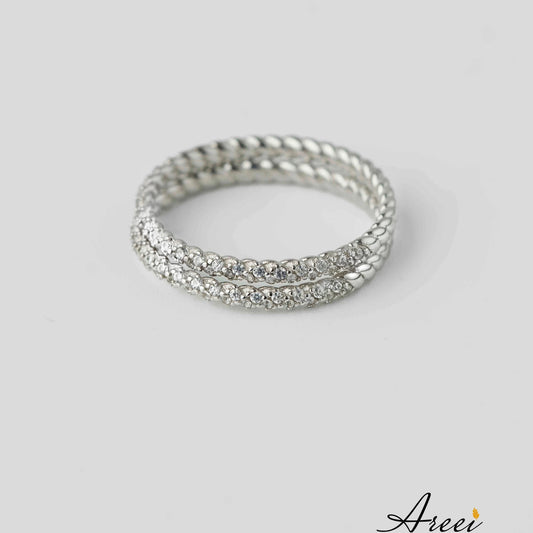
If you are building a new stack from scratch, it is worth browsing designs made specifically with stacking in mind. At Areei, our ring collection has a range of slim bands and stacking-friendly designs that are built to sit comfortably together without excess movement.
2. Use Ring Adjusters or Sizing Beads
Ring adjusters, sometimes called sizing beads or ring guards, are small clear or metal inserts that fit inside the band of a ring to reduce the internal circumference. They are inexpensive, widely available, and can be fitted at home in minutes. This is an ideal solution if a ring fits well everywhere except for slight looseness that causes spinning.
3. Try Spiral or Textured Bands
Flat, plain bands with smooth interiors are more prone to sliding against one another. Swapping one or two rings in your stack for a spiral design, a twisted band, or a textured surface introduces friction points that help keep the whole stack anchored in place. This is a popular styling trick among those who stack five or more rings at once.
4. Solder or Fuse Your Stack Together
For a stack you wear every single day and never plan to rearrange, permanently soldering the rings together is a long-term fix. A jeweller can fuse two or more bands at a single contact point, allowing them to still move slightly as a connected unit but preventing any individual ring from rotating independently. This method works particularly well for wedding and engagement ring sets that are always worn in the same combination.
5. Add a Ring Connector
If soldering feels too permanent, ring connectors offer a removable alternative. These small clasps or links attach two rings together at one point, holding them in a fixed position relative to one another while still allowing you to separate them later. Connectors are especially useful for engagement ring and wedding band pairings.
6. Choose Rings With a Flat or Contoured Profile
Contoured or shaped bands, designed to nestle against the curve of another ring, naturally stay aligned better than generic round bands. When shopping for pieces intended to sit alongside an existing ring, look for a contoured or curved profile designed to hug the neighbouring band. Our rings collection includes several contoured styles designed with stacking in mind.
7. Mind the Weight Distribution
If one ring in your stack carries a large stone or heavy setting, try positioning it towards the base of the stack, closer to the knuckle, rather than at the tip of the finger. This reduces leverage and makes it less likely to swing around during hand movement.
Final Thoughts
A spinning ring stack is a common problem, but it is rarely one without a solution. Start with the basics: correct sizing and a well-considered arrangement of textures and profiles. From there, small additions such as sizing beads, connectors or a professional soldering job can make an enormous difference to how secure your stack feels throughout the day.
If you are looking to build or refresh your own ring stack with pieces designed to complement one another, take a look at our full ring collection for stacking-friendly bands, contoured designs and statement pieces to anchor your look.